And honestly, I’m not completely sure where this decision will take me either.
There is a strange thing about being asked what you want to do with your life.
People expect an answer.
- Doctor.
- Engineer.
- IAS officer.
- Pilot.
- Entrepreneur.
- Something.
A word that sounds confident enough to fit inside a form.
I remember being asked this when I was younger.
Everyone seemed to have an answer ready.
I didn't.
At the time, people thought I was joking.
I wasn't.
I genuinely didn't know.
Years later, I still don't have a perfectly defined ambition.
But something has changed.
I don't know exactly where I'm going.
I just know what I want to try next.
And for the first time, I think that's enough.
There Was a Version of Me Who Was "Good at Studies"
If you've only known me recently, this might sound slightly unbelievable.
I used to be very good at mathematics.
Until around fifth grade, I studied at a nearby matriculation school. I regularly scored above 90%, and mathematics was one of the subjects where I was especially comfortable.
Those kinds of marks weren't unusual for me.
And yes, I know what someone might say.
"Bro, you were in fifth grade. Of course fifth-grade math was easier."
That's fair.
I'm not claiming that solving fifth-grade mathematics makes someone a mathematical genius.
It doesn't.
What matters to me isn't how difficult the mathematics was.
It's how I approached it.
I remember something from around fourth grade.
During a holiday, I had an accident. When school reopened, I didn't immediately go back.
I was at home with an exercise notebook that had a lot of pages.
And I started solving problems.
Not because someone was sitting next to me telling me what to study.
Not because I was preparing for some huge examination.
Sometimes I didn't even properly know which chapter or topic a problem belonged to.
I just solved it.
Page after page.
When I eventually went back to school, my teachers noticed what I had been doing.
They were surprised.
Looking back, that story feels more important to me now than the marks themselves.
Because I think there was already something there.
I didn't always need someone to tell me what I was supposed to learn.
Sometimes I simply wanted to find out whether I could figure something out.
I didn't have the vocabulary for it then.
I wouldn't have called it curiosity.
I definitely wouldn't have called it self-directed learning.
I was just a kid with an exercise notebook.
But maybe that was the beginning.
Then Something Changed
After COVID, my academic life went in a very different direction.
I moved from the school environment I had grown up in into Kendriya Vidyalaya and the CBSE/NCERT system.
People often compare school systems.
One is supposedly easier. Another is supposedly harder. One has a different syllabus. Another has a different exam pattern.
Maybe those differences matter.
But eventually I started noticing something bigger.
No matter which system you're in, the conversation around students eventually becomes very similar.
- Get good marks.
- Get good marks in tenth.
- Get good marks in twelfth.
- Get the cutoff.
- Choose a good course.
- Get into a good college.
- Get a job.
There is nothing inherently wrong with that.
In fact, I'm still trying to get good marks.
I still care about my board examinations.
I still worry about Physics, Chemistry and Mathematics.
I still think about cutoffs.
I still wonder what happens if my marks aren't good enough.
I don't believe the comforting version of the argument that says marks don't matter.
They do.
Degrees matter. College can matter. Conventional careers matter. Financial stability matters.
My parents are not wrong when they tell me to keep another option open.
The problem is that somewhere along the way, I started wondering whether these things should be the only way we understand a person's ability.
Because the contrast in my own life is almost ridiculous.
The kid who once came home with pages of mathematics problems is now a Grade 12 student who struggles with PCM.
Grade 11 was especially difficult for me.
There were times when simply getting through the year felt like an achievement.
And now I'm here, worrying about marks and cutoffs while knowing that the subjects that matter so much on paper aren't necessarily the subjects where I feel strongest.
That's difficult to explain.
Especially to people who remember the older version of me.
Some of my old teachers might still remember that student.
The one who used to get those marks.
The one who used to solve problems independently.
If I went back there today, they might ask what happened.
They might ask about my marks.
They might ask what I'm planning to do after school.
And honestly, I wouldn't blame them.
They couldn't have known what would happen.
Neither did I.
Then Lockdown Gave Me a Completely Different Classroom
My academic story might have looked completely different if COVID had never happened.
But it did.
And during lockdown, I discovered Telegram.
At first, it was nothing serious.
It was just an app.
Then I discovered bots.
Then I became curious about how they worked.
Then came Python. Then APIs. Then GitHub. Then databases. Then servers. Then automation. Then projects. Then more projects.
I started meeting people online who were building things.
Some knew much more than me. Some answered my questions. Some gave me ideas. Some introduced me to things I didn't even know existed.
And slowly, programming stopped being something I was merely learning.
It became something I was doing.
I wrote about this journey in another post, I'm Glad I Became a Developer Before the AI Era.
Sometimes I look back at what I built during lockdown and think about how strange the timing was.
Back then, some of the things I made felt genuinely impressive to me.
Today?
Some of them are almost ordinary.
A person can describe an application to an AI and get a working prototype surprisingly quickly.
Someone who has barely written code can now build things that would have taken me days of searching, debugging and experimenting when I started.
And I actually think that's incredible.
I'm not interested in pretending AI isn't changing everything. It is. The things I once had to figure out manually are becoming easier for more people to access. A kid today can open an AI tool, describe an idea, and create something.
That's not something I want to complain about. It's progress.
But it does make me think.
If the things I built when I was younger have become common, then what exactly was valuable about those years?
Maybe it wasn't the code.
Maybe it was the habit.
The habit of seeing something and asking:
"How does this work?"
Then:
"Why does it work that way?"
Then:
"Can I change it?"
Then:
"Can I build my own version?"
That's what I hope stays with me.
AI can write code. It can explain code. It can generate an application.
But I still want to understand what I'm building.
I still want to question it.
I still want to be able to tell when something doesn't make sense.
And I still want to make things.
Maybe that is where I still belong.
I don't know exactly what that place will look like.
But I don't think my place disappeared just because the tools became easier.
Sometimes I Wonder About the Person I Could Have Become
This is where my brain does something slightly annoying.
I think about alternate versions of myself.
What if I had never installed Telegram? What if I had never found bots? What if I had never met the people who taught me things? What if nobody had answered my early questions? What if lockdown had happened differently? What if I had stayed completely focused on academics? What if I had prepared seriously for JEE? What if I had chosen NEET? What if I had simply followed the most conventional path available to me?
There could be hundreds of versions of me.
One of them might still be the mathematics student. Another might be preparing for an entrance examination. Another might be studying something completely unrelated to technology. Another might never have discovered programming at all.
And none of those versions would necessarily be wrong.
That's what makes this difficult.
There isn't always one obviously correct timeline.
Sometimes a life changes because of something ridiculously small.
A message. A download. A YouTube video. A random person answering a question. A project you almost didn't open.
You never know which small event will redirect you.
And that makes me wonder about the decision I'm making now.
I've Asked Too Many People
I've spoken to seniors. Developers. College students. Working professionals. Relatives. People from different generations.
I've asked for advice because I genuinely wanted to understand what I was getting myself into.
Everyone had something useful to say.
Some told me to get a degree. Some told me to focus on skills. Some told me to choose stability. Some told me to take risks. Some told me to keep every option open.
My parents have their own perspective.
My grandmother calls and tells me to get good marks because she is waiting to see what I score.
My father keeps reminding me that I should have another option even if I choose a less conventional path.
I understand where they're coming from.
They lived in a different world.
Their experiences with education, work and financial security are different from mine.
Their advice comes from what they have seen.
I respect that.
But eventually I realized something uncomfortable.
I had collected so many people's opinions that I almost forgot I was the person who had to live with the decision.
Advice can help you see a road. Nobody else can walk it for you.
The Financial Reality
There is another part of this that makes it complicated.
It would be easy to write an essay about following your passion if money wasn't part of the equation.
But it is.
I'm not from a family where education is an unlimited expense.
My father works hard, and if I choose an expensive college, it can mean borrowing money or taking a loan.
That isn't some abstract number on a spreadsheet. It is my family's money. It is my father's responsibility. It is the kind of decision that can affect people beyond me.
And when my father talks about taking a loan for my education, I don't hear:
"You must follow this particular path."
I hear:
"I am willing to take a financial risk because I want my son to have a future."
That carries weight. I don't want to waste that.
So when I think about my future, I'm not only asking: "What do I want?" I'm also asking: "What is reasonable for my family?"
That's part of why the current job market worries me. I've seen enough stories of graduates struggling to know that the old formula (good marks → good college → guaranteed job) isn't a guarantee anymore.
The Conventional Path Isn't the Enemy
I don't want this to become another article saying that college is useless.
It isn't.
I don't want to say JEE is useless.
It isn't.
I don't want to say NEET is useless.
It isn't.
For someone who wants to become a doctor, NEET is part of the path.
For someone targeting certain engineering institutions, entrance examinations can be important.
For many careers, degrees are necessary.
And for many people, college is where they find their friends, mentors, knowledge and opportunities.
I might go to college too.
That's still possible. Very possible.
If I do, I won't consider that decision a failure.
Because college doesn't define my future.
And honestly, neither does the decision I'm making today.
If I go to college, I can still come back to the kind of work and direction I'm aiming toward now.
If I don't go immediately, I can still change my mind later.
If something doesn't work, I can take another route.
I can learn independently. I can work. I can study again. I can change direction. I can return to a conventional path.
The destination isn't locked just because I choose one road first.
That's important to me.
I'm not choosing my entire life right now.
I'm choosing what I want to experience next.
What Makes Me Question the Usual Path
I've seen students start preparing for major entrance examinations immediately after school.
I've seen families spend significant amounts of money on coaching.
I've seen people change their minds later.
I've seen someone spend around ₹1.5 lakh on preparation and eventually decide that the path wasn't what they wanted.
That doesn't mean the preparation was automatically pointless.
Maybe they learned something. Maybe they discovered what they didn't want. Maybe the experience helped them make a better decision later.
But it made me ask a question.
How much should we invest in a direction before we understand whether we actually want it?
That's not an attack on competitive examinations.
It's a question about decision-making.
We sometimes treat a seventeen-year-old's decision as if they are supposed to know exactly what they want from the next forty years.
I'm seventeen.
I'm supposed to be learning. I'm supposed to be experimenting. I'm supposed to make some wrong turns. I'm supposed to discover things.
Maybe that's why I don't want to pretend that I already have everything figured out.
I've Heard "Education Needs to Change" for Years
One of my teachers once said something that stayed with me:
"If I become Prime Minister, I will build a completely different school, focused on skills."
That sentence stayed in my head.
Not because I think traditional education is completely useless. It isn't.
Fundamentals matter. Mathematics matters. Science matters. Writing matters. History matters.
There are things worth learning even when we don't immediately see their application.
But I also understand what my teacher meant.
Sometimes I sit in a classroom and hear a question like:
"Who is going to apply this in real life?"
And I have wondered the same thing.
At the same time, I also know that not everything we learn needs an immediate practical application.
The problem, to me, is when education becomes almost entirely about proving that you remember something at a particular moment.
Learn → Prepare → Write → Get marks → Forget → Repeat.
There are other ways to learn.
Projects. Mentorship. Communication. Collaboration. Building. Making mistakes. Solving problems that don't come with an answer key. Being responsible for something real. Learning from people who have actually done the thing you're trying to understand.
I've heard people complain about education for years.
Eventually I started asking myself a different question.
If I keep saying education needs to change, why can't I at least experience an environment that is trying to do it differently?
I'm not claiming I can fix education.
I'm not even claiming I know what the perfect education system looks like.
I just want to experience another possibility.
Maybe the Biggest Thing I'm Looking For Is People
This might actually be more important than the education model itself.
I want to meet people.
Not necessarily people who are exactly like me.
I don't need everyone around me to love programming.
I don't need everyone to care about APIs or databases or AI.
I just want people who are genuinely curious about something.
People who can spend hours talking about an idea because they actually care about it.
People who build. People who ask questions. People who can teach me something. People I can teach something to. People who are not afraid to say, "I don't know."
Where I am now, sometimes I feel like I'm forcing the conversation when I start talking about technology.
Not because the people around me are bad. They aren't. They simply have different interests. And that's completely normal.
Online, I've met people who can suddenly turn a random conversation into a two-hour discussion about some technical problem, a project, a bot, a weird idea or something they discovered.
I want to know what it feels like to have that kind of environment around me physically too.
Maybe the thing I'm looking for isn't another textbook.
Maybe it's my people.
Not copies of me. Just people with the same willingness to explore.
I Want to Leave Without Running Away
There is another thing I want to make very clear.
I don't want to move somewhere else because I hate where I am.
I don't.
I don't think my hometown is beneath me.
I don't think the people around me are holding me back.
And I don't think leaving automatically makes someone successful.
If I don't take the path I'm considering, I might stay here.
I might go to a nearby college.
I might study somewhere else.
Maybe I'll eventually move somewhere completely different.
There are many possibilities.
But if I get the chance to experience a different environment, I want to take it because I want exposure.
Different people. Different perspectives. Different conversations. Different problems. Different responsibilities.
A chance to become more independent.
A chance to discover how I behave when everything familiar isn't immediately around me.
Maybe I'll become more confident.
Maybe I'll realize I still have a lot to learn.
Maybe I'll discover that I was wrong about some things.
Good.
I'd rather discover that through experience than spend years wondering.
I'm not running away from home.
I'm trying to expand my definition of home.
The World Changed While I Was Growing Up
When I started building things during lockdown, the internet felt like a place where you could find almost anything if you were willing to search long enough.
Now AI can bring much of that knowledge to you immediately.
The difference is enormous.
And I don't want to fight that change.
I want to grow with it.
I want to be someone who can use AI without becoming dependent on it.
Someone who can ask better questions because they understand the fundamentals.
Someone who can build faster without forgetting to think.
Someone who can work with people.
Someone who can explain an idea.
Someone who can admit when they don't know something.
Someone who can learn something new when the old thing becomes obsolete.
Because technology will keep changing.
The tools I use today might look primitive in a few years.
The projects I'm proud of today might become ordinary.
Maybe things I spend weeks learning will eventually be automated.
That's okay.
I don't want my identity to depend on one tool.
I want it to depend on my ability to learn.
Maybe I'm Wrong
There is a possibility that I'm making the wrong decision.
I have thought about that.
A lot.
Maybe I choose this path and later think:
"Bro, why did you do that?"
Maybe it doesn't work the way I imagined.
Maybe the environment isn't what I expected.
Maybe I struggle.
Maybe I miss home.
Maybe I realize that I actually wanted college.
Maybe I change my mind completely.
But here's something I have slowly learned.
My future self will always know things that my current self doesn't.
That's unavoidable.
If future me looks back and disagrees with today's decision, that doesn't automatically mean today's decision was stupid.
I can only make decisions using the information I have now.
And if I learn something new later, I can make another decision.
That's how life works.
So yes.
Maybe this is a mistake. Maybe it works. Maybe it doesn't.
I'm okay with finding out.
The Scoreboard Problem & Believing in My Talent
This might be the most important part.
My marks have changed.
My academic performance has changed.
My confidence has changed.
My plans have changed.
The world around me has changed.
But I still believe there is something in me worth developing.
I don't mean that in an arrogant way.
I don't think I'm automatically special.
I don't think knowing technology makes me better than someone who gets better marks than me.
I don't think building projects makes me more valuable than someone following a completely different path.
Because people aren't leaderboards.
Ahead according to what?
Behind according to what?
Marks measure something. Projects measure something else. Examinations measure something. Curiosity measures something. Communication measures something. Discipline measures something.
None of these measurements, alone, can describe an entire human being.
I've had people tell me things like:
"You know more than my college senior."
Or:
"You know more than someone working in IT."
I don't take those comments as proof that I'm better than anyone.
Sometimes they're probably exaggerated.
What they remind me of is something simpler:
The version of me that looks behind on one scoreboard might be ahead on another.
And that means I shouldn't let one measurement completely define what I believe I can become.
I still have a lot to learn.
A lot.
But I still believe in my ability to learn it.
I Don't Know Where This Goes
Maybe I'll go through with this decision. Maybe I won't. Maybe I'll end up in college. Maybe I'll take a different route. Maybe I'll return to college later. Maybe I'll change careers. Maybe I'll build a company. Maybe I'll work for someone. Maybe I'll do something I haven't even heard of yet.
That's the funny thing.
I'm seventeen.
There are entire industries I haven't discovered. Entire people I haven't met. Entire places I've never seen. Entire versions of myself that don't exist yet.
Why would I pretend I know exactly what I'm going to become?
I don't.
And I don't think I need to.
What I do know is that I don't want to spend the next few years making decisions purely because they are the decisions everyone expects me to make.
I want to understand myself through experience.
I want to learn. I want to build. I want to meet people. I want to be challenged. I want to become independent. I want to keep conventional options open. I want to make my parents' sacrifices worth something.
I want to prove to myself that the curiosity that started with a notebook full of mathematics problems and eventually turned into years of building things wasn't just a phase.
And I want to find out what happens when I give that curiosity a different environment.
So, Where Am I Going?
I don't know.
That's the honest answer.
And maybe that's the entire point of this post.
A few years ago, I didn't know what I wanted to do.
Today, I still don't know the final destination.
But I know more about myself.
I know that I'm curious. I know that I like building. I know that I learn differently when I'm interested. I know that people can change the direction of a life without even realizing it. I know that marks matter, but they aren't the whole story. I know that degrees matter, but they don't own my future. I know that college can be valuable, but college doesn't define who I become. I know that AI is changing the meaning of technical skill, and I want to understand where I fit into that change.
And most importantly, I know that the decision I make today does not have to imprison the person I become tomorrow.
If I go to college, I can still come back to the direction I'm aiming toward today.
If I don't, I can still choose college later.
If I fail at something, I can try something else.
If I discover that I was wrong, I can change.
The path can change without the curiosity disappearing.
So no, I don't have a perfect five-year plan.
I don't have a beautiful answer for every question.
I don't know exactly where I'll live.
I don't know exactly what I'll become.
I don't even know whether the decision I'm making now will be one of the best decisions I've ever made or simply one of the decisions that taught me something important.
But I know what I want to do next.
I want to step outside what I already know. I want to meet people I haven't met. I want to see a different way of learning. I want to test myself. I want to experience something instead of endlessly asking other people whether I should.
And then I'll decide what comes after that.
Maybe that's all a seventeen-year-old really needs.
Not an answer for the next forty years.
Just enough courage to take the next step.
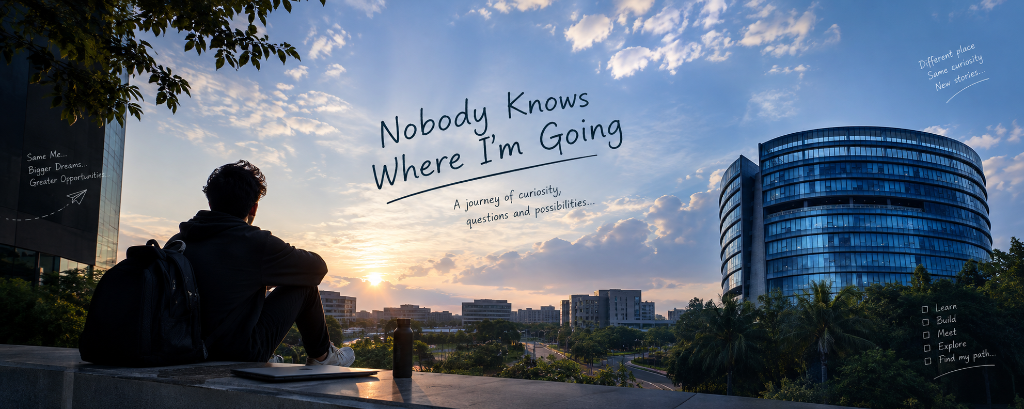
Because nobody knows where I'm going.
And honestly, I'm okay with that.