Sometimes, the first certificate you receive isn't proof of what you've achieved. It's a reminder of where everything began.
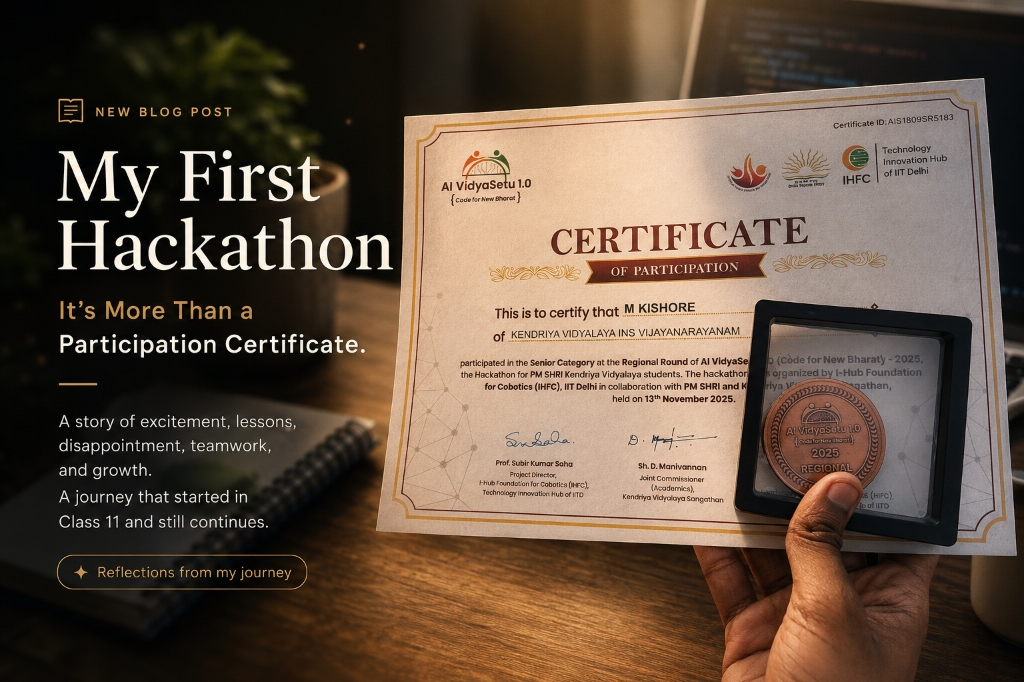
Today, I finally received the medal and certificate from my very first hackathon.
Someone looked at it and casually said,
"It's just a participation certificate."
I smiled.
Because they weren't wrong.
It is a participation certificate.
It doesn't say Winner.
It doesn't say Runner-Up.
It doesn't even say we qualified for the next round.
Yet somehow...
it's one of the most meaningful certificates I've ever received.
Not because of what it says.
But because of everything it reminds me of.
To understand why, we have to go back to where it all started.
It started on an ordinary school day
If someone had asked me that morning whether I'd be writing a blog post about that day years later, I probably would've laughed.
It was just another Computer Science period during Class 11.
The bell rang.
Everyone was getting ready to leave the Computer Science lab.
We were about to leave when our Computer Science teacher stopped us.
She told us something unexpected.
There was going to be a hackathon exclusively for Kendriya Vidyalaya students.
There would be multiple rounds—regional, zonal, and perhaps even further for the teams that qualified.
Our school could send two senior teams—one boys' team and one girls' team.
I had heard the word hackathon before.
But I had never participated in one.
To me, it sounded exciting.
Not because I imagined winning.
Not because it meant missing classes.
But because I finally had an opportunity to build something outside the classroom.
I simply thought I was signing up for a competition. I didn't realize I was signing up for a lesson I'd remember years later.
That single announcement would quietly become one of the biggest turning points in my journey.
Building a team
Like most school competitions, we had to form a team.
Five members.
No more.
No less.
My friend Chris Jeyan joined almost immediately.
Both of us already had a little programming experience.
Nothing extraordinary.
We weren't experts.
We were simply curious enough to spend our free time learning things beyond our syllabus.
The remaining three members were also friends, but each of them had their own reason for joining.
One chose Computer Science simply because our school didn't offer Commerce, and he preferred staying in a familiar environment instead of changing schools.
Another joined because he assumed the coding work would mostly be handled by the rest of us.
The last teammate had other priorities, so the hackathon wasn't his main focus.
At that time, none of this seemed important.
I thought we all had the same goal.
Looking back...
we really didn't.
"Tech Shifter"
Every team needed a name.
Our mentor—who was also our Computer Science teacher—named ours:
Tech Shifter.
Even today, whenever I think about that name, I can't help but laugh.
Tech Shifter.
I'm still not entirely sure what exactly got shifted.
Maybe our perspective.
Maybe our confidence.
Maybe just our classroom.
Whatever it was...
the name stayed with us throughout the competition.
The bootcamps
Before the regional round, AI VidyaSetu organized a series of bootcamps to prepare participants.
For me, they were unlike anything I'd experienced before.
Instead of memorizing textbook definitions for an exam, we were introduced to concepts that actually solved problems.
Searching algorithms.
Logical thinking.
Computational problem solving.
Programming challenges.
At the time...
it felt overwhelming.
If I'm being completely honest, I don't think anyone in my team truly understood everything being taught.
Including me. We listened, took notes, and tried our best to keep up, but many of the concepts felt completely new.
I remember sitting there thinking,
"How do people even come up with solutions like this?"
Today, after spending more time learning Data Structures and Algorithms, many of those problems seem surprisingly straightforward.
Funny how learning works.
The questions didn't become easier.
I simply became better equipped to understand them.
Looking back now, I have one regret.
I wish I had taken those bootcamps more seriously.
Not because they would've guaranteed a better result.
But because opportunities like that don't come around every day.
Sometimes you only realize how valuable an opportunity was after it's already gone.
Skipping classes... accidentally
The bootcamps happened during school hours.
This meant we occasionally had to leave regular classes to attend them.
As a Class 11 student...
I wasn't exactly complaining.
Who wouldn't enjoy escaping a few lectures?
But surprisingly, not every teacher saw it that way.
We weren't skipping classes for fun. We were attending sessions that the school itself had nominated us for. Ironically, that was difficult for a few teachers to believe. I always found that a little funny.
We weren't wandering around campus.
We weren't wasting time.
We were officially representing our school in a national-level student initiative.
Still, from their perspective, it probably looked like another excuse to miss class.
I don't blame them.
But I remember thinking,
"We're actually trying to learn something here."
Ironically, those sessions taught me more about problem-solving than many of the classes I missed.
Looking back
At the time, I thought the hackathon was about building a project.
I thought success meant qualifying for the next round.
I thought technical knowledge alone would make the difference.
I couldn't have been more wrong.
The real lessons hadn't even begun yet.
The regional round was still ahead.
And so was the disappointment that would eventually change the way I thought about teamwork, responsibility, and learning itself.
That, however...
is a story for the next chapter.
The day everything felt real
Eventually, the day arrived.
The regional round.
The excitement that had been building over the previous weeks suddenly became real.
No more bootcamps.
No more "we'll learn it later."
This was the day we had to apply whatever we had learned.
Looking back, I don't remember waking up nervous.
I remember waking up excited.
It was my first hackathon.
I was finally going to experience something I'd only heard developers talk about online.
We weren't the same team I imagined
Before the competition, I believed something that, in hindsight, was incredibly naive.
I thought everyone on the team wanted the same thing.
I assumed everyone wanted to learn.
I assumed everyone would spend time preparing.
I assumed everyone was just as curious as I was.
They weren't.
And that's perfectly okay.
People join the same event for completely different reasons.
Some genuinely wanted to learn.
Some simply wanted the experience.
Some enjoyed the opportunity to miss a few regular classes.
Some probably joined because their friends were joining.
None of those reasons are wrong.
They're just... different.
The problem wasn't that people had different motivations.
The problem was that I expected everyone to think like I did.
That expectation quietly became the biggest mistake I made throughout the entire hackathon.
The questions
Once the competition started...
reality hit.
The problems weren't impossible.
They were simply unfamiliar.
Many questions tested logical thinking.
Some involved searching techniques.
Some required programming concepts that weren't part of our everyday school lessons.
A few even touched on Object-Oriented Programming.
At that moment, everything felt difficult.
I kept staring at certain questions, wondering,
"Where do I even begin?"
It's funny how perspective changes.
Today, if someone handed me those same questions, I'd probably approach them very differently.
Not because the questions became easier.
Because I've spent the last year learning things I didn't know back then.
That's one of my favorite things about learning.
The mountain you once struggled to climb eventually becomes a hill you barely notice.
Looking for someone to blame
When the pressure started building...
I made another mistake.
I looked for someone to blame.
My friend Chris was our team leader.
Whenever something didn't go as planned, I quietly blamed him.
Maybe we should've prepared differently.
Maybe the team should've organized things better.
Maybe someone should've taken more responsibility.
Back then, it felt easy to point at the person leading the team.
Today...
I regret doing that.
Looking back, I wasn't completely right, and I wasn't completely wrong either. Every team member, including me, could have contributed more.
Leadership is one of those responsibilities that seems simple until you're the one carrying it.
Making decisions for five different people isn't easy.
Keeping everyone motivated isn't easy.
Making sure everyone contributes equally isn't easy.
Chris wasn't perfect.
None of us were.
Including me.
Looking back now, I realize something important.
Instead of asking,
"Why didn't my teammates do more?"
I should've asked,
"What more could I have done?"
That single question changed the way I think about teamwork.
The result
A few days later...
the results were announced.
We hadn't qualified for the zonal round.
It was over.
I remember feeling disappointed.
Not because I expected a trophy.
But because I genuinely believed we had a chance.
For the next few days, I kept replaying everything in my head.
What if we had prepared more?
What if I had paid closer attention during the bootcamps?
What if our team had communicated better?
What if...
Like most "what if" questions...
none of them changed the outcome.
A question I'll never forget
Then something happened that stayed with me far longer than the result itself.
Our Computer Science teacher looked at me and asked,
"Kishore, what happened? You didn't qualify?"
That question caught me completely off guard.
I wasn't the team leader.
I wasn't the person responsible for every decision.
Yet somehow...
she expected more from me.
At first, I didn't understand why.
Later, I realized something.
Maybe she wasn't asking because she expected me to win.
Maybe she asked because she knew I cared.
And if I'm being honest...
I expected more from myself too.
Not because we lost.
But because I knew I could've contributed more.
That question stayed with me long after the competition ended.
It wasn't about qualifying.
It became a reminder that responsibility isn't something you're officially given.
Sometimes people simply trust you enough to expect more.
And when they do...
you either grow into that expectation...
or learn from falling short of it.
The biggest lesson wasn't technical
For a long time, I believed that hackathons were mainly about coding.
Winning.
Building projects.
Learning new technologies.
Those things certainly matter.
But they're not what stayed with me.
What stayed with me was understanding people.
Understanding that curiosity can't be forced.
Ownership can't be assigned.
Motivation can't be borrowed.
A team isn't simply five people working on the same project.
It's five people moving toward the same goal.
When those goals are different...
even talented people struggle to work together.
That realization eventually became one of the most meaningful things I've ever shared on LinkedIn.
The post wasn't really about the hackathon.
It was about the people.
The expectations.
The lessons.
Because when I looked back...
I realized the hackathon hadn't taught me algorithms.
It had quietly taught me something much harder.
How to become a better teammate.
And more importantly...
how to become a better person.
When the competition ended, I thought the story had ended too.
I put the experience behind me.
Moved on to new projects.
Learned new technologies.
Built new things.
Life continued.
I never imagined that almost a year later...
a simple medal and a participation certificate would bring every one of those memories back.
Almost a year later
Life moved on.
School became busier.
Projects replaced old memories.
The hackathon slowly became another chapter of my journey.
Until today.
Like most school days, I walked into the classroom a little late.
One of my teammates looked at me and said,
"Hey, we got our hackathon medals!"
For a moment, I was confused.
"Medals?"
I knew we'd eventually receive participation certificates.
But I never expected there would be medals too.
When I looked towards the front of the classroom, our Computer Science teacher had already placed the medals and certificates on the table.
One by one, she called our names.
When mine was called, I walked up, collected my certificate and medal, thanked her, and returned to my seat.
It wasn't a grand moment.
There were no cameras.
No speeches.
No celebration.
Just another ordinary school day.
But as I sat there holding that certificate, something felt different.
I wasn't looking at a medal.
I was looking at memories.
Memories of my first hackathon.
The bootcamps.
The excitement.
The disappointment of not qualifying.
The lessons I didn't realize I was learning.
For everyone else, it was probably just a participation certificate.
For me...
it was a reminder of where everything began.
"It's just a participation certificate."
While everyone was collecting their certificates, I overheard a few classmates talking.
Some said,
"It's just a participation certificate." "Maybe I should've gone too, because they're giving it for no reason—just for wasting time and skipping classes."
Others joked that they could've joined too.
Maybe they were right.
Maybe anyone could have participated.
But not everyone did.
And that's what made me stop and think.
A participation certificate isn't valuable because it says Participation.
Its value comes from what you participated in.
If you frame a participation certificate simply as "I showed up," then yes, it doesn't sound very special.
But if that participation becomes the beginning of something much bigger...
then suddenly that small piece of paper means a lot more.
More than paper
When I looked at the certificate again, I realized it wasn't reminding me of the result.
It reminded me of everything around the result.
It reminded me of rushing to the computer lab after classes.
The bootcamps.
The confusing algorithm questions.
The excitement of getting our participant medals.
The conversations with teammates.
The disappointment of not qualifying.
My teacher asking,
"Kishore, what happened?"
And the lessons I didn't realize I was learning at the time.
Funny enough...
I don't even remember every question from that hackathon anymore.
But I remember exactly how it made me feel.
That's probably how memories work.
You rarely remember every detail.
You remember how something changed you.
The first chapter
Sometimes we celebrate the wrong things.
Winning is celebrated.
Certificates are celebrated.
Medals are celebrated.
Those moments deserve recognition.
But I think we forget to celebrate beginnings.
Nobody celebrates their first line of code.
Nobody frames the first project that never worked.
Nobody proudly talks about the bug that took three days to solve.
Yet those moments are where every story begins.
This certificate isn't my biggest achievement.
Not even close.
But it represents the beginning of many achievements that came afterwards.
Without this hackathon...
there might never have been the confidence to build larger projects.
There might never have been the curiosity that pushed me deeper into backend development.
Maybe I wouldn't have started documenting my journey.
Maybe this blog wouldn't even exist.
Sometimes one ordinary experience quietly changes the direction of everything that follows.
You don't notice it while it's happening.
You only recognize it when you look back.
Looking at the younger version of me
Sometimes I think about the Class 11 version of myself.
The one who walked into the hackathon believing technical skills alone would solve everything.
The one who expected every teammate to care as much as he did.
The one who blamed others before questioning himself.
The one who thought not qualifying meant failure.
If I could go back and tell him one thing, it would probably be this:
"You'll learn far more from this experience than you realize."
Not immediately.
Not next week.
Maybe not even next month.
But eventually.
Because growth is strange.
Sometimes the biggest lessons don't arrive when the event ends.
They arrive months later...
when you finally understand what the experience was trying to teach you.
Why I wanted to write this
A few months ago, I shared a LinkedIn post about the biggest lesson this hackathon taught me.
It wasn't really about the competition.
It was about teamwork.
Ownership.
Choosing the right circle.
That post told the lesson.
This blog tells the story behind it.
Social media is great for sharing moments.
But some moments deserve more than a timeline.
Some deserve a place where they can stay.
Years from now, I know I'll forget the number of likes that LinkedIn post received.
But I hope I never forget why I wrote it.
Or why this certificate mattered enough to deserve an entire blog.
What this certificate really represents
Today, if someone asked me what this certificate means...
I wouldn't say,
"It's my participation certificate."
I'd say,
"It's my first hackathon."
It's the first time I worked on a problem bigger than a classroom assignment.
The first time I experienced the excitement and pressure of building something as a team.
The first time I realized that learning doesn't always happen inside a textbook.
The first time I understood that failure and growth often arrive together.
And perhaps most importantly...
the first time I discovered that curiosity rewards those who keep showing up.
Every developer has a beginning.
Some remember their first "Hello, World."
Some remember their first Git commit.
Some remember their first open-source contribution.
When I think about mine...
I'll always remember this hackathon.
Before I end this story
Maybe this medal won't impress everyone.
Maybe this certificate will always be "just a participation certificate" to some people.
That's okay.
Not every achievement has to be understood by everyone.
Its value doesn't come from how others see it.
It comes from what it represents to the person holding it.
Years from now, someone might ask me,
"Where did your journey as a developer really begin?"
I probably won't open GitHub.
I won't show my portfolio.
I won't start with my latest project.
I'll probably smile...
take out this certificate...
and say,
"It started here."
Not because this was my greatest achievement.
But because every great journey deserves to remember its first step.
The certificate says "Participation."
The memories say "Beginning."